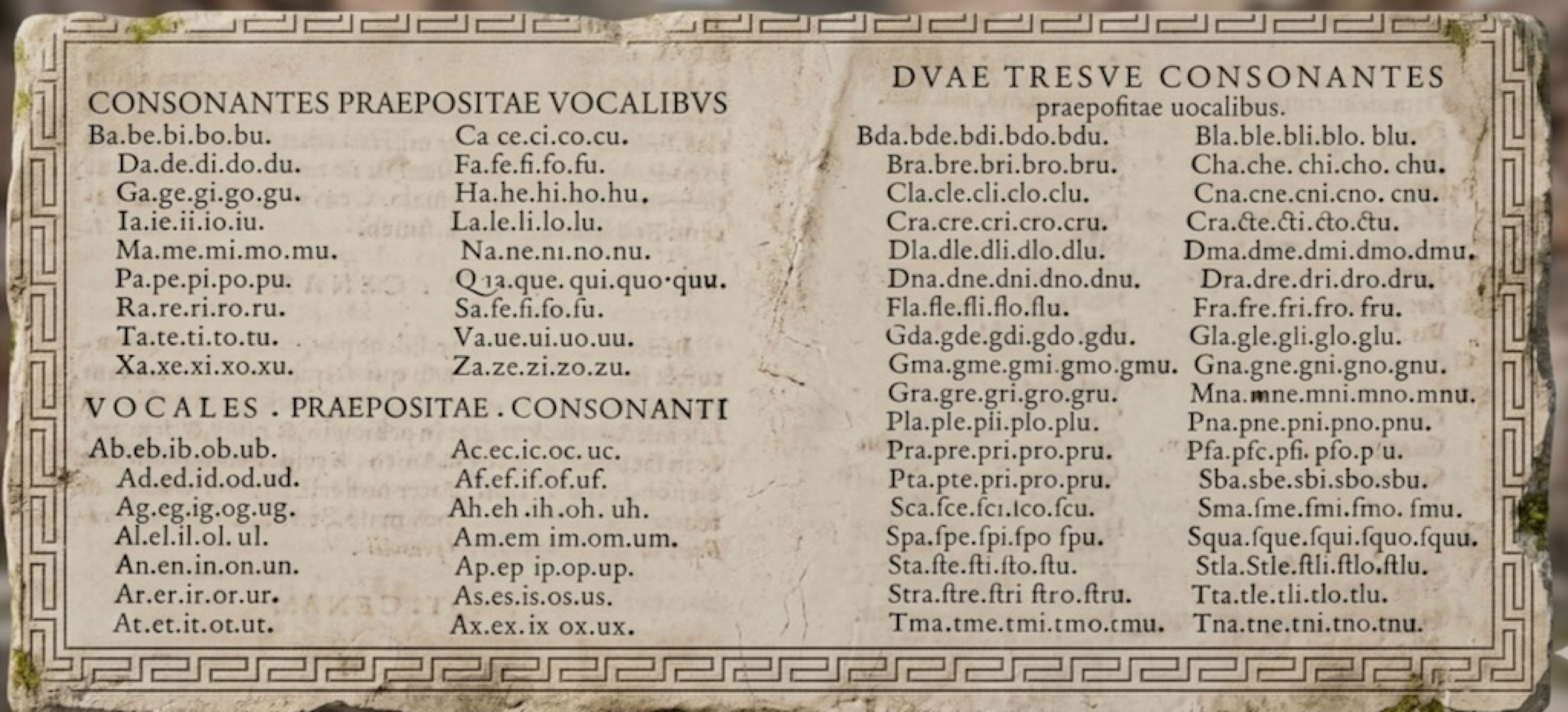
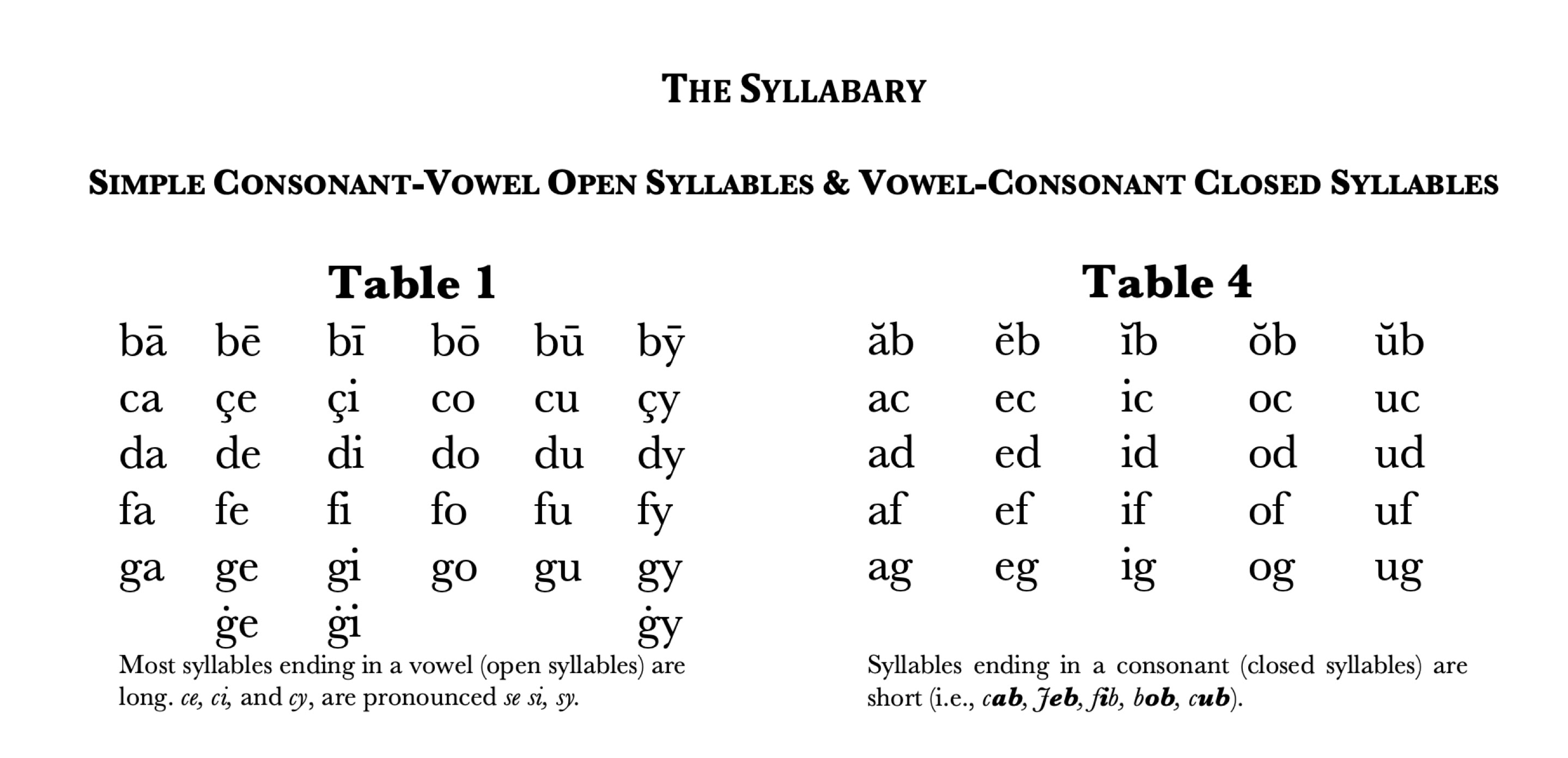
Syllabic Phonics teaches phonics using syllables as a starting point. The list of syllables for a language is called a syllabary. A portion of a Latin syllabary is shown above. Syllables are the smallest natural sound unit of speech. Geraldine Rodgers calls them the true atoms of reading instruction. See our dyslexia page for a more detailed explanation.
The syllabary usually excludes syllable letter combinations that are not found in words of that language.
With syllabic phonics, students first learned to spell and read the basic syllables in the syllabary, then read and spelled words divided into syllables.
History of Syllabic Phonics, Latin and English
The teaching of reading with syllables has been around since at least 95 AD, when Quintilian spoke of their use in the teaching of reading. Quintilian mentions the teaching of syllables in his Institutes of Oratory, Institutio Oratoria, and advises teachers to make haste slowly:
“30. For learning syllables there is no short way. They must all be learned throughout, nor are the most difficult of them, as is the general practice, to be postponed, that children may be at a loss, forsooth, in writing words.
31. Moreover, we must not even trust to the first learning by heart; it will be better to have syllables repeated and to impress them long upon the memory; and in reading too, not to hurry on, in order to make it continuous or quick, until the clear and certain connection of the letters become familiar, without at least any necessity to stop for recollection. Let the pupil then begin to form words from syllables and to join phrases together from words.
32. It is incredible how much retardation is caused to reading by haste; for hence arise hesitation, interruption, and repetition, as children attempt more than they can manage; and then, after making mistakes, they become distrustful even of what they know.
33. Let reading, therefore, be at first sure, then continuous, and for a long time slow, until, by exercise, a correct quickness is gained" (1)
“The teaching of beginning reading remained unchanged until the eighteenth century A. D. Children first learned the alphabet, and then learned the syllabary, but they continued to spell each syllable as it was practiced, using the current letter names.
It was only after they learned the syllabary that they read connected texts, usually Latin prayers after about 300 A. D. They then read those texts syllable by syllable until they became proficient readers.
Until the sixteenth century A. D. in English-speaking countries, beginning reading was taught in Latin, and, in much of Europe, beginning reading continued to be taught in Latin until the eighteenth century." (2)
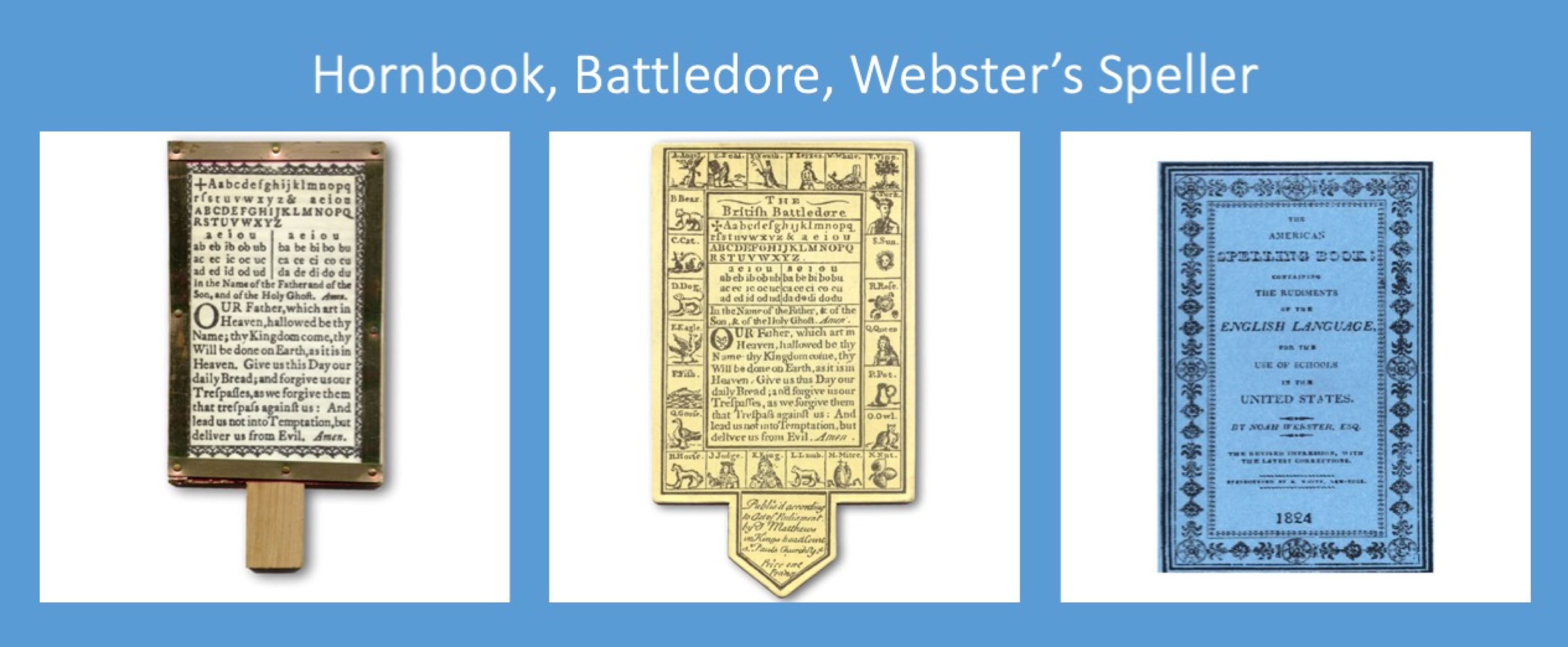
While the method may have remained the same, changing technology led to a change in the method in which the syllables were taught. At first, syllables were taught on wax tablets, then a hornbook, then a battledore, then spelling books (spellers) that started with a syllabary.
An exceptionally clear and practical description of the English syllabic method appears in John Brinsley’s Ludus Literarius: or, The Grammar School (1612, with a 1627 edition). In Chapter III, “Of reading English speedily,”
Brinsley explains how children should first master the five vowels, then combine each consonant with those vowels to form syllables (ba, be, bi, bo, bu, etc.), practice difficult syllable combinations, and finally join syllables into complete words—exactly the same step-by-step process later used in hornbooks, battledores, and Webster’s Speller.
He emphasizes daily short spelling drills, pronouncing every syllable distinctly, and reading the New Testament aloud so that children can enter grammar school already reading fluently, often in under a year and sometimes in as little as six weeks. A typed excerpt of this portion of the Grammar School is available online.
Noah Webster defined "spelling-book" as "A book for teaching children to spell and read" in his 1828 Dictionary. (3)
Geraldine Rodgers believes that Noah Webster's speller, The American Spelling Book, was the first use of Synthetic Phonics, which she calls "Pascal phonics," and said:
“Noah Webster improved this basic spelling book method by what amounted to the addition of Pascal phonics in his American Spelling Book. ”
— Why Noah Webster's way was the right way (4)
Prior spellers such as Dilworth's used analytic phonics.
“Dilworth’s speller, which had been so popular in America, and which Noah Webster said he had used as a boy in the 1760’s, taught reading by analytic sound." (5)
The syllable method was also called the “alphabet method” or the “ABC method.”
“The alphabet method was used without any rivals until about 1820,
and even after that it persisted in the United States
alongside whole word and phonic
methods until about 1870.”
- E Jennifer Monaghan, Writing the Past:
Teaching Reading in Colonial America and the United States, 1640-1940. (6)
These spellers started with a syllabary, then had later words of more than 2 syllables divided to show their pronunciation. Some readers also had syllables divided to aid pronunciation. See our syllable divided books page for examples.
For more detailed information about how Webster’s Speller was used in the past and is still used today, see 40L’s Webster’s Way page.
Excerpt from the syllabary in Webster’s 1908 Elementary Spelling Book (Don Potter edition)
Syllabic Phonics in Latin and French
Historically, syllabic phonics was taught in Latin first, then your native alphabet. This teaching of syllables is explained in Geraldine Rodgers’ History of Reading instruction. Another source explaining how Latin was historically taught with syllables is Latinum. See the article Teaching: An Historical Perspective by Evan der Millner, August 2010. Click on read more, the article continues below the line:
“Basic education started off with the alphabet, followed by the learning of syllables – extensive tables of syllables were composed. (Bonner,1977, Education in Ancient Rome). Each consonant was in turn combined with the five vowels – ba be bi bo bu, ca ce ci co cu, and so on, through the alphabet.”
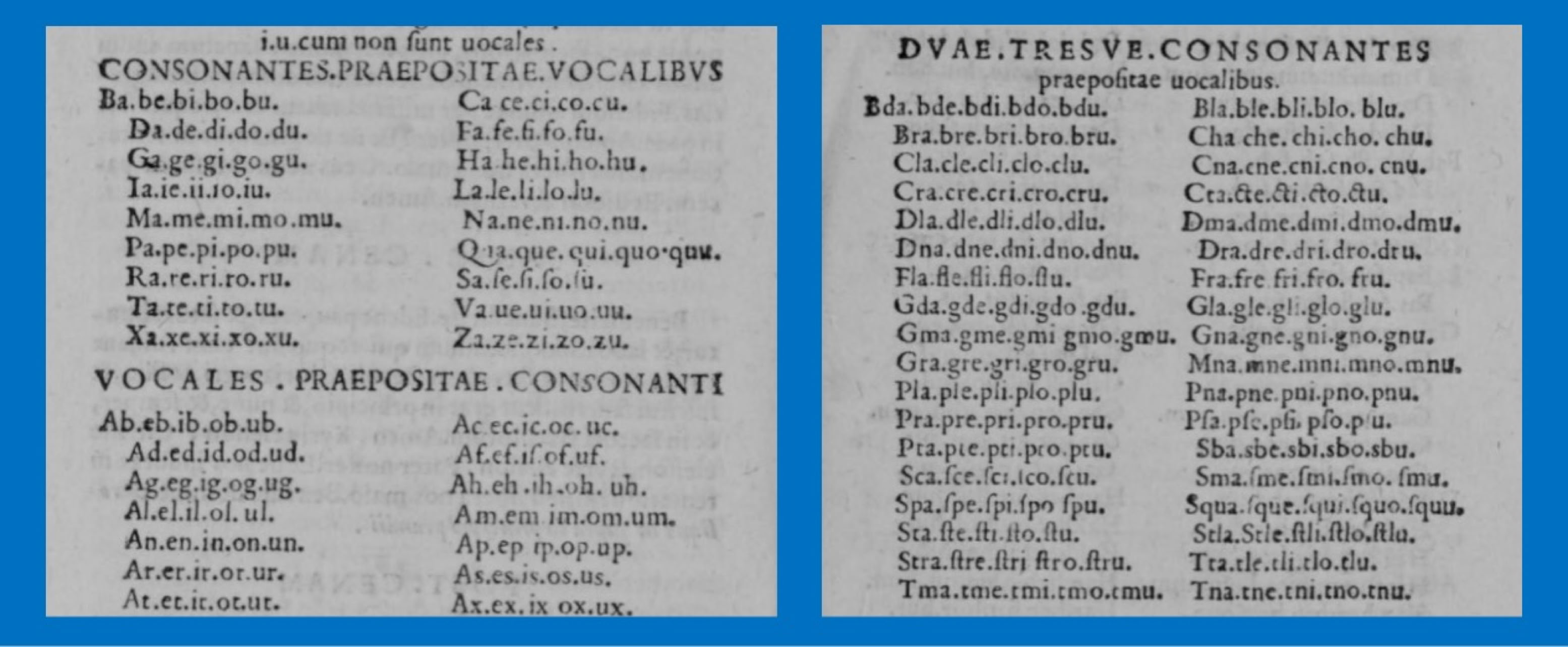
A Latin syllabary can be seen in the book Aldi Pii Manutii Grammaticarum institutionum libri. 4. Eiusdem De uitiata uocalium ac diphthongorum prolatione Parergon. Accessit index locupletissimus. by Manuzio, Aldo, 1575. It is available to view on Internet Archive. The syllabary is on pages 20 - 25. Excerpts from these pages are shown below.
Portion of a 16th-century Latin syllabary from Aldus Manutius (1575)
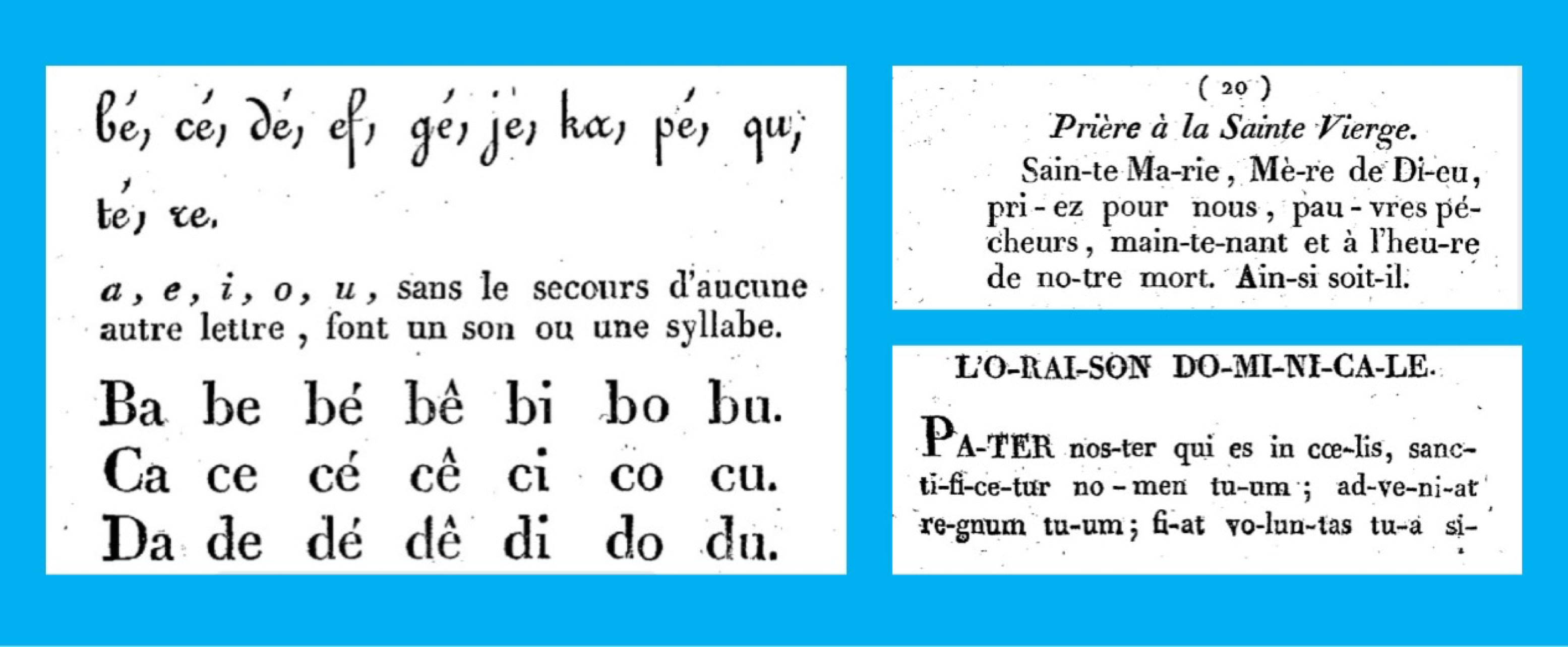
The 1817 book Alphabet syllabique français et latin, ou Méthode ingénieuse et facile pour apprendre à lire en peu de temps has syllables and syllable divided words in both French and Latin. It is available to view in full online from Gallica, the digital library of the Bibliothèque nationale de France.
There are a variety of historical and current books that use syllabic phonics in French. Typical titles and search terms to use to find syllabic phonics books in French are shown below.
• "Alphabet syllabique français"
• "Méthode ingénieuse syllabique"
• "Syllabaire premier livre de lecture français"
French syllabic methods are often called "méthode syllabique," "méthode alphabétique-syllabique," or simply "b.a.-ba" (building from letters to syllables to words.)
Portion of a French syllabary, French and Latin syllable divided text,
Alphabet syllabique français et latin, 1817
Syllabic Phonics in Spanish
There are many examples of Spanish syllabic phonics methods.
A modern example text is the book La Pata Pita, a read aloud book for beginners. For better retention, use with a workbook such as Mi método de lectura.
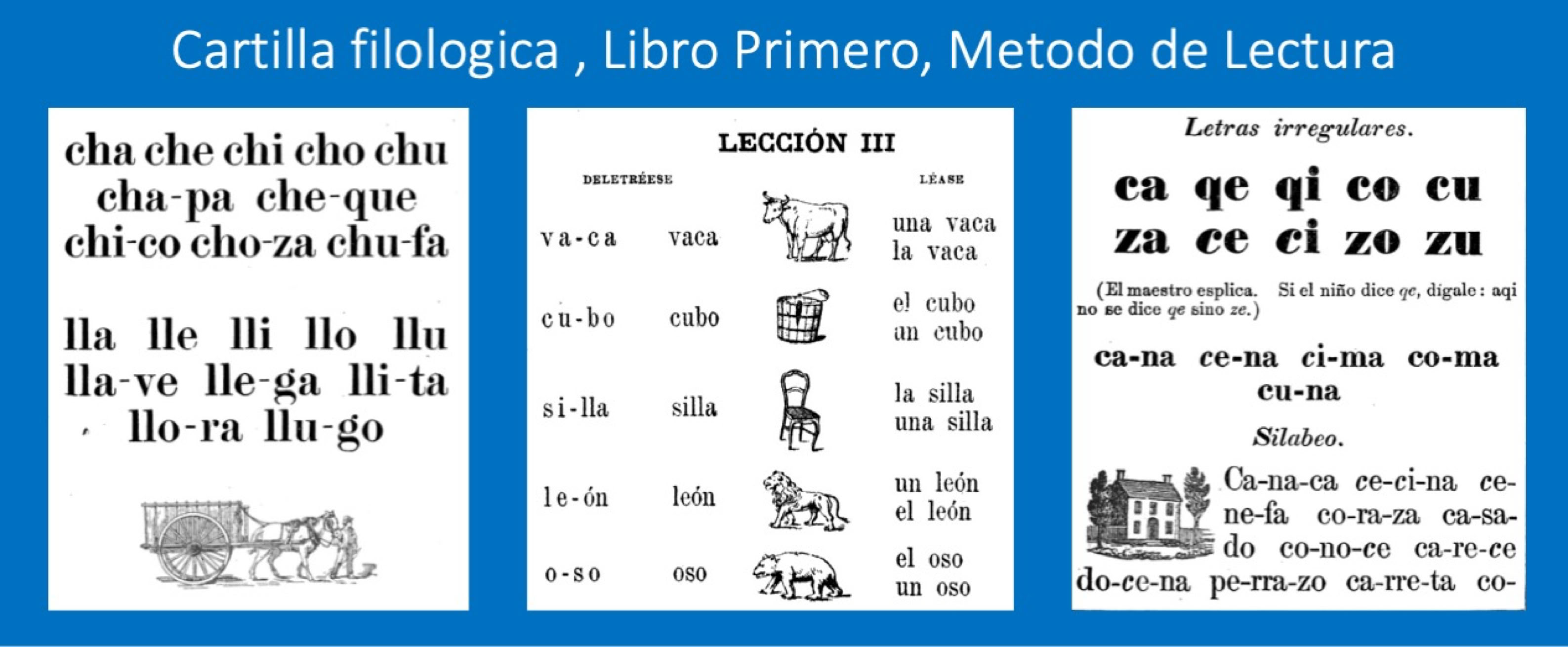
Older Spanish syllabic phonics books are plentiful. Many "cartillas" or "silabarios" are syllable based. Search "silabario español” or "cartilla de lectura silábica,” on Google Books for more. A few examples:
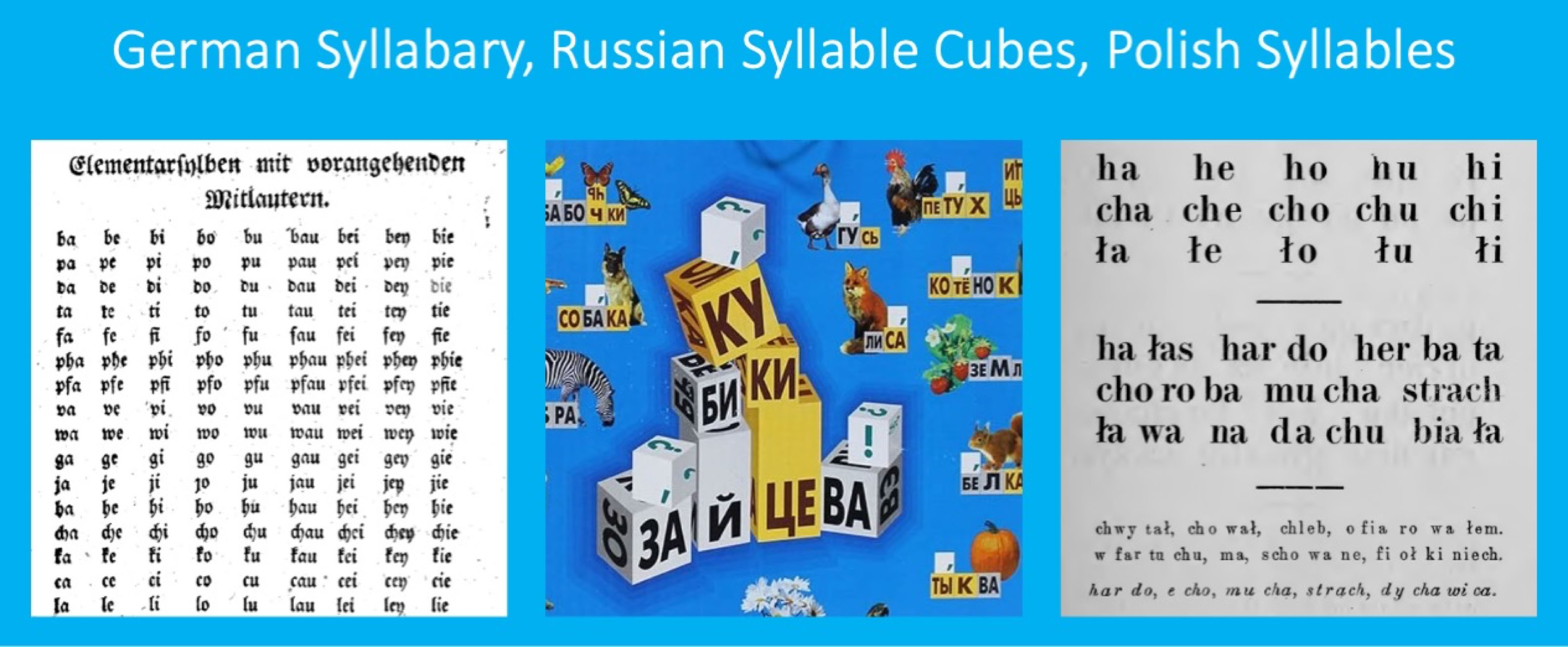
Syllabic phonics methods are also available in many other European languages, including Slavic languages such as Polish and Russian. Books using syllabic phonics in a few of these languages are shown below.
Italian primers commonly used “sillabario” tables (ba-be-bi-bo-bu style) before moving to reading exercises, example books below:
In German, syllabic phonics are referred to as "Silbenmethode." ABC der Tiere by Mildenerger is an example, a modern book that can still be ordered. The title includes the phrase “zu Lesen in Silben,” which translates to “to be read in syllables.”
A historical German example available on Google books is ABC und Lesebuch fur die katholische Schuljugend in Rheinbaiern by Ritter, 1827.
A modern Russian syllable based book is available, Bukvar. The syllables for teaching Russian are also available as cubes designed by Nikolai Zaitsev, similar to alphabet blocks but with syllables instead of letters.
Nowy elementarz polski; czyli, Mały sylabikarz dla dzieci polskich w Ameryce by Władysław Dyniewicz, 1874
Syllabaries in Syllabic vs Alphabetic Languages
Some languages are inherently syllabic and use true syllabaries as their primary writing system, most European languages employ syllabaries as a teaching aid.
Japanese relies on hiragana and katakana, complete syllabaries where each character stands for a syllable. Cherokee uses a dedicated syllabary created in the 19th century.
In contrast, alphabetic languages such as English, Spanish, French, German, Italian, Polish, and Russian use syllable charts purely to help beginners master pronunciation patterns and sound blending before they move on to whole words.
Advantages of Syllabic Phonics
In syllable-timed languages such as Latin, Spanish, Italian, and French, each syllable is pronounced with equal length. Syllabic phonics leverages the natural timing of these languages.
English is a stress-timed language: syllables are not equal in length. Stressed syllables are longer and clearer, while unstressed ones are often reduced to the neutral schwa sound (/ə/, like the “uh” in “about”). This creates the uneven “galloping” rhythm familiar to native speakers but challenging for learners from syllable-timed languages such as Spanish, French, or Italian. Syllabic phonics helps bridge this gap by building mastery of natural speech units first.
Noah Webster’s Speller takes it even further. Multi-syllable words are arranged by their accent pattern, with the primary accented syllable highlighted. This explicit highlighting of English stress patterns makes pronunciation predictable and prevents the common ESL pitfall of giving every syllable equal weight. 40L volunteers have found this arrangement “especially helpful for students whose native language is not English,” as it mirrors the syllable-by-syllable foundation of the classic syllabary while teaching the stress-timed realities of English.
Try our free Syllables Spell Success lessons to see the power of syllabic phonics for yourself. The lessons go to the 12th grade level, ending with Noah Webster’s table of “words of 8 syllables.”