View from window in Mont Saint Michel, France.

The 

Phonics 

Page

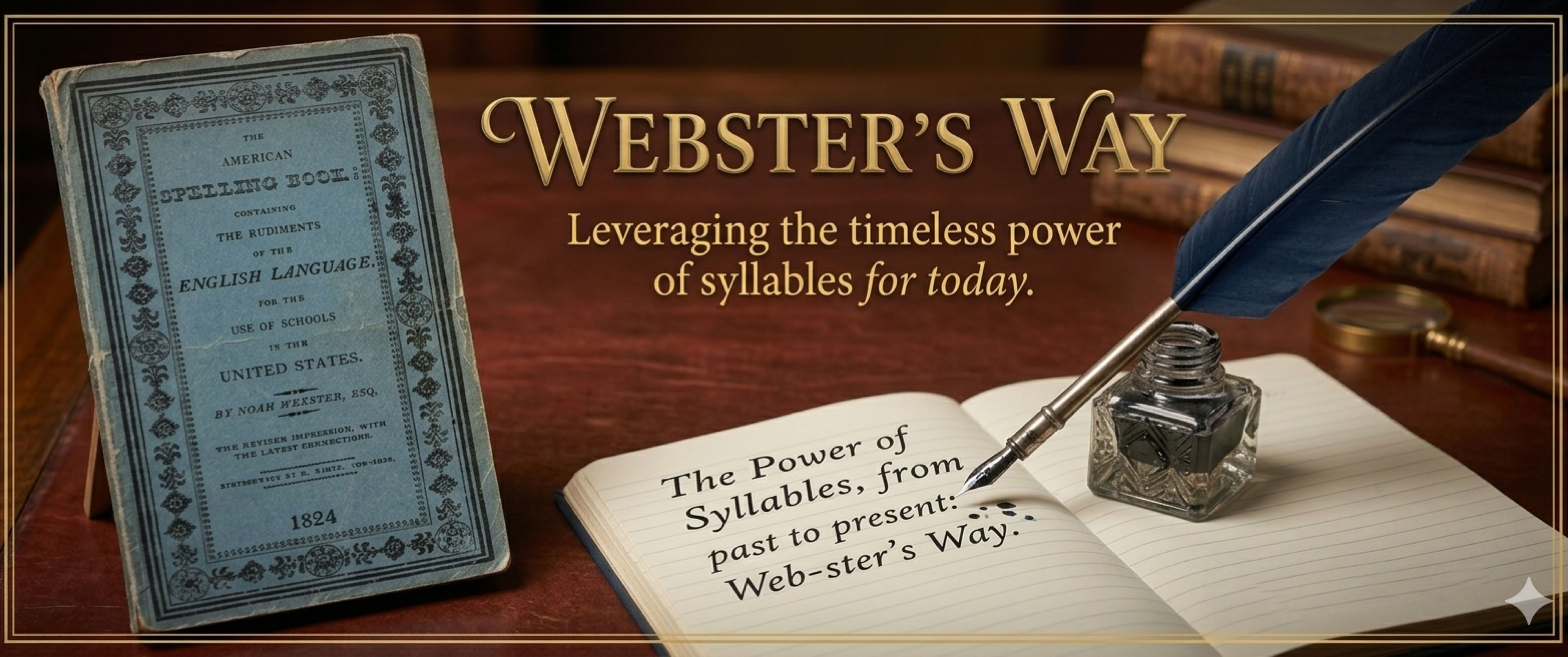
Writing with Quill pen, Blue-Backed Speller book, text "Webster's Way, leveraging hte timeless power of sylalbles for today"

Webster’s Way.


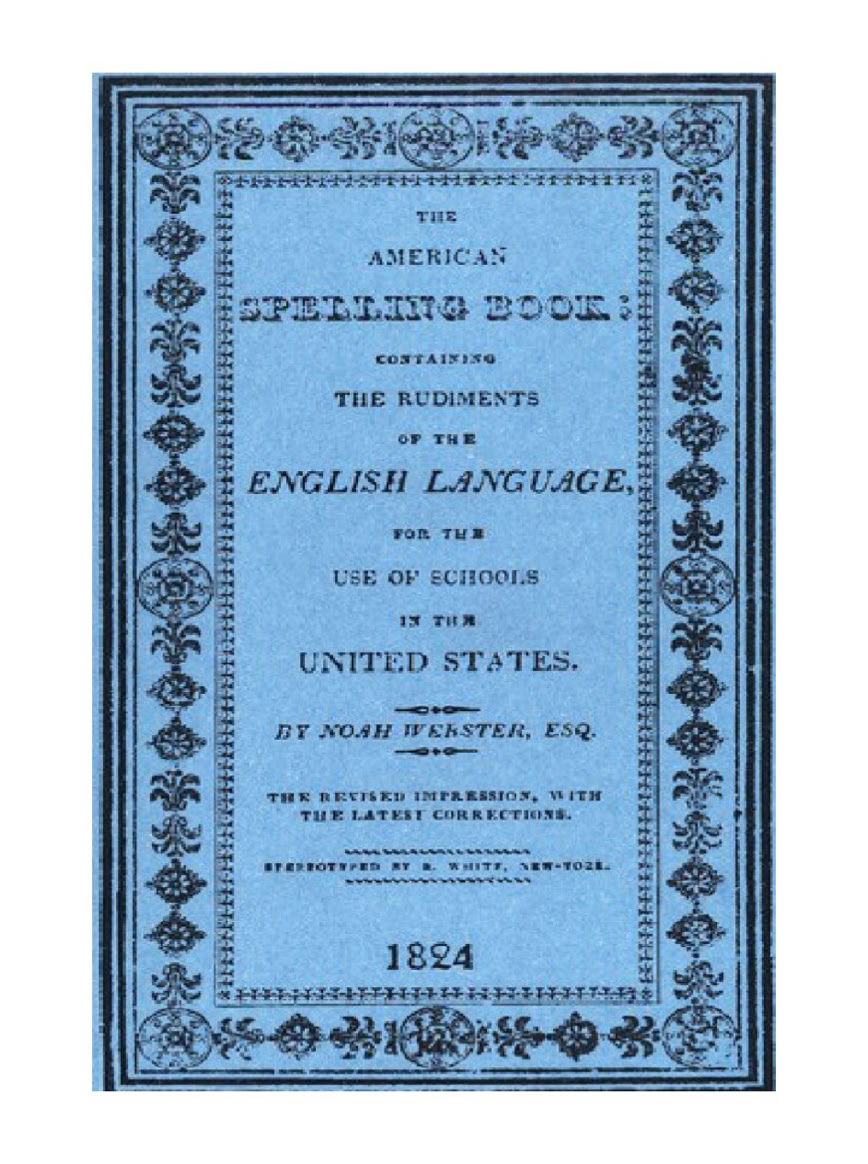
Imagine the literacy journey of yesteryears when students learned to read with nothing but a syllabary and a speller, like the famed Webster’s Blue-Backed Speller.


Reviving the nearly lost art of syllabic phonics, 40L volunteers have achieved remarkable success teaching reading by incorporating Noah Webster's Speller into the free Syllables Spell Success lessons. This approach, emphasizing spelling and syllable mastery, has propelled students to read and spell far beyond their grade levels, proving its enduring effectiveness.  


As Geraldine L. Rodgers says in her article Why Noah Webster's Way Was the Right Way, "The teaching of beginning reading remained unchanged until the eighteenth century A. D. Children first learned the alphabet, and then learned the syllabary, but they continued to spell each syllable as it was practiced.”


The main focus of the teaching when using Webster's Speller was the thorough memorization of the syllabary. As Geraldine L. Rodgers explains in her book, "The History of Beginning Reading,"

The syllable pages with the “abs” [ab, eb, ib, ob, ub] in such spelling books after 1826 were seldom used, even at the fourth grade when such spellers were usually introduced. 


The fact that such syllable pages were not used is shown by their excellent condition in surviving spellers printed after 1826. Yet, in spelling books surviving from before 1826, the syllable pages are often tattered or missing. Before 1826, the syllable pages became tattered or worn out because little beginners were using them very heavily in learning to read by “sound.”

Syllables

In the preface to his 1851 edition of "Parker's First Reader," R.G. Parker explains the importance of learning the sounds and spellings of syllables:


"Among the many pupils that I have had under my charge, I have noticed that they who have made the most rapid progress in reading were invariably those who had been most faithfully drilled in the spelling book."


Here's how vowel sounds work in syllables:


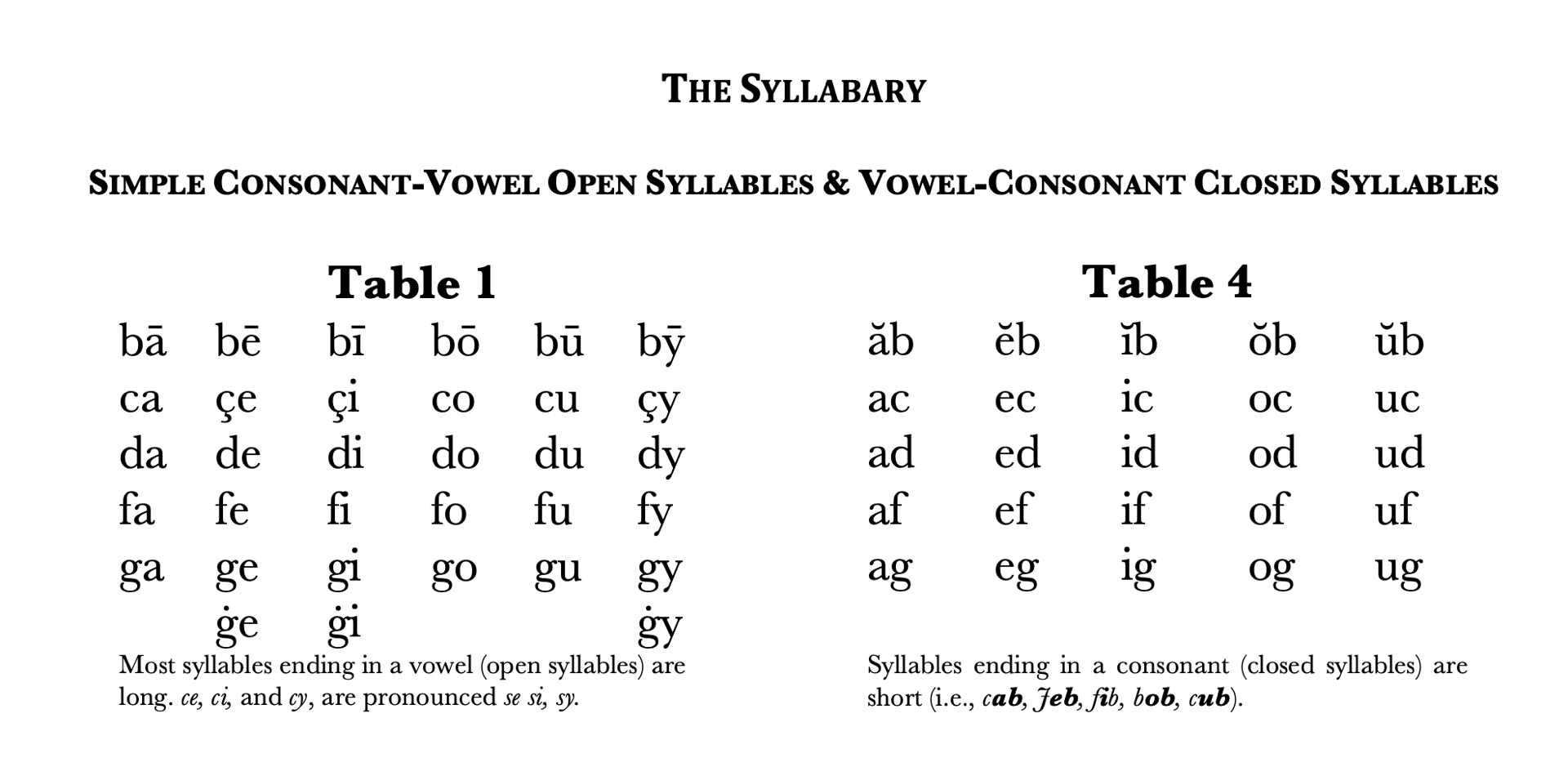
Short Vowel Sounds: When a syllable ends with a consonant, the vowel sound is short: ab, eb, ib, ob, ub.

Long Vowel Sounds: Conversely, when a syllable ends with a vowel, it has a long vowel sound: ba, be, bi, bo, bu, by. 


Words like ma and pa have the sound of ah, but syllables have the long sound of a as in ba-by, la-dy, & ma-ker. (There are separate rules for ending -y which depend on whether or not the final syllable is accented.)


Students should learn to sound out and spell the syllables in the syllabary before they move on to sounding out words.  



Tables from Webster’s Speller

After being taught basic syllables such as those shown in the excerpted Syllabary from Webster’s Speller avoce, students would be given words with syllables divided according to their pronunciation. The syllable divided words were divided to match the teaching in the syllable tables in the syllabary. 


Words with 2 or more syllables were divided to make them easy for children to pronounce, instead of typical dictionary division.


For example, the dictionary will divide the word “rabbit” as “ra-bit” to show the consonant “b” as pronounced with the 2nd syllable, but spellers and syllable divided books divide it as “rab-bit” to help children pronounce the word with its short vowel sound.


    Speller division: rab-bit 

    Dictionary division: ra-bit 


Noah Webster’s son, William G. Webster, in his 1866 revision of his father’s Blue-Backed Speller, “The Elementary Spelling Book,” explains the reasoning behind this syllable division choice:


In Syllabication it has been thought best not to give the etymological division of the Quarto Dictionary, but to retain the old mode of Dr. Webster as best calculated to teach young scholars the true pronunciation of words. 


The plan of classification here executed is extended so as to comprehend every important variety of English words, and the classes are so arranged, with suitable directions for the pronunciation, that any pupil, who shall be master of these Elementary Tables, will find little difficulty in learning to form and pronounce any words that properly belong to our vernacular language.


-W. G. W.       New York, 1866.

Using Webster’s Speller Today


When teaching students of mixed ages or abilities, spend a little time on the syllabary daily. Then, let each student work on spelling and sounding out the table they are working on. If they get stuck on a syllable, direct them to the relevant part of the syllabary. Have them recite the row, then focus on the tricky syllable before returning to the word. 


With practice, they'll resolve issues independently. Soon, your syllabary will be as worn as those used the syllabary in Webster’s day.


40L volunteers have found that the schwa-accent pattern arrangement of words in Webster’s Speller especial helpful for students whose native language is not English. 


For more about how you can use Webster's speller, watch the videos on our YouTube Webster's Speller Playlist or see them integrated into our Syllables Lessons.


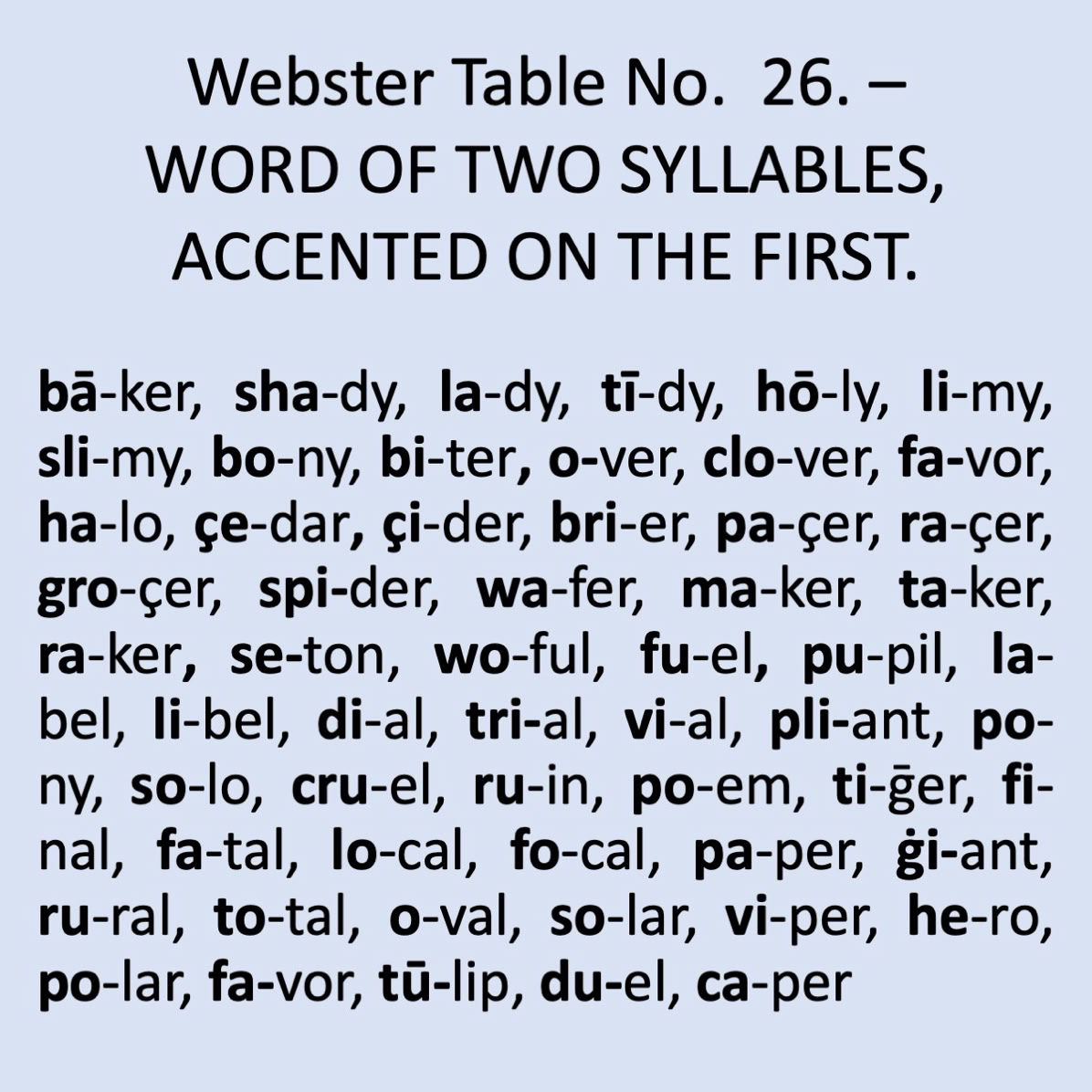
Webster's Speller's focus on spelling and syllables basics helps students later take on words from Table 26 like ba-ker, sha-dy, vi-per, and ce-dar with ease. 


By the time they get to lesson 10 of the syllables lessons, they get excited as they sound out words like im-ma-te-ri-al-i-ty, in-di-vis-i-bil-i-ty, and per-pen-dic-ū-lar-i-ty. (From Webster table number 121.)


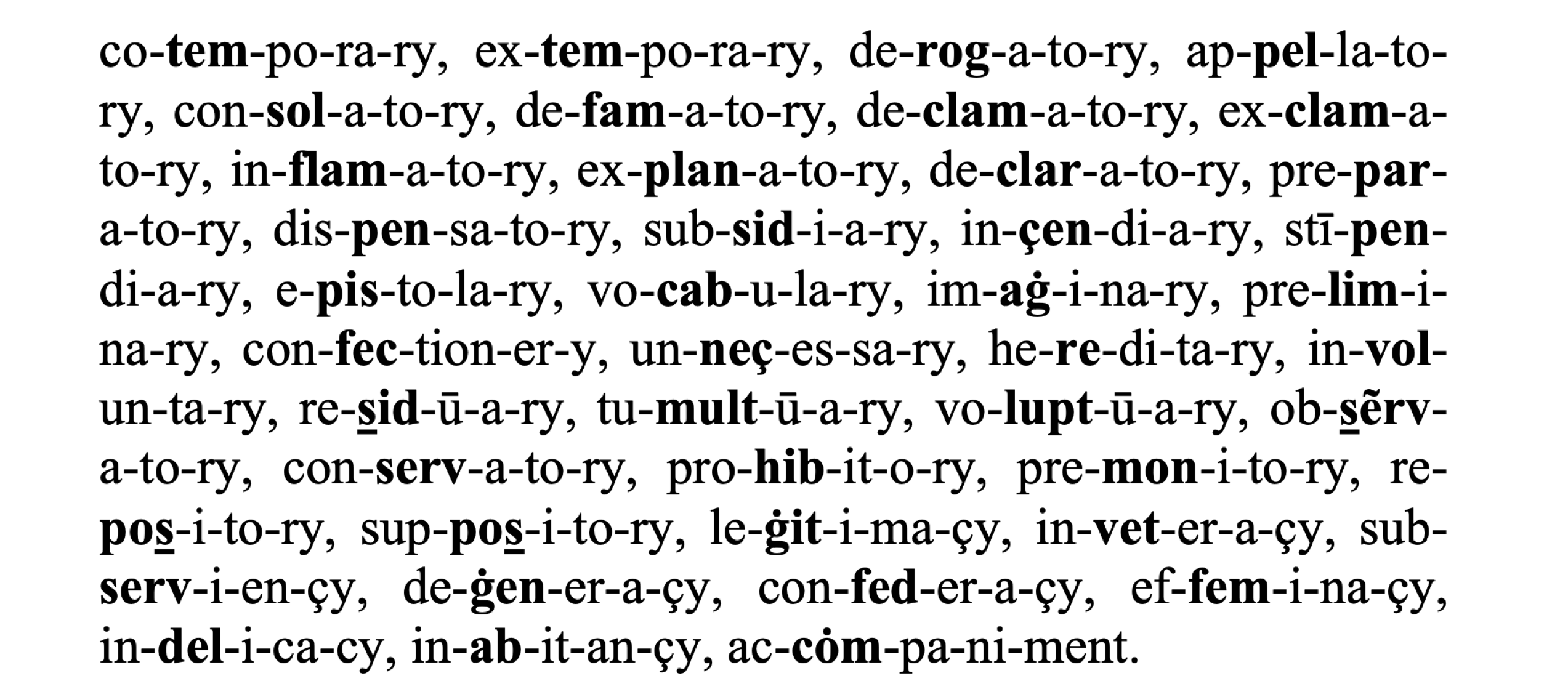
Webster Table No. 102

Webster’s Speller in the Past


In the late 1800s, books with words divided into syllables based on Webster's Speller were created. Many are available as reprints today, and some can be read on Google Books. Visit our Syllable Divided Books page for links and more on this phenomenon.


Webster's Speller, remarkably simple to use, required no instructions or teacher's manual. Teachers in one-room schools learned it through repeated exposure, making formal guidance unnecessary. Its simplicity is so widely understood that it often gets just a brief mention in historical accounts. Interestingly, the clearest insights into its use come from the education sections of the Slave Narratives, offering a unique and powerful perspective on its role in teaching.


In her book, “Marva Collins’ Way,” Marva talks about syllabic phonics: “My grandmother used to read aloud to me from her Bible, sounding out words by syllables. She had learned to read and spell by syllables when she was in school.”


The Speller Slave Narratives page explains how Webster’s Speller and other Spellers used through quotes from the 17 volume Born in Slavery: Slave Narratives from the Federal Writers' Project, 1936 to 1938.


Timeless Teaching with Webster’s Speller


40L wishes you success with teaching Webster's Speller, hoping this 18th-century classic thrives in modern 21st-century education. Initially designed for One-Room Schoolhouses, it's versatile enough for any teaching environment—from one-on-one tutoring and homeschooling to public and private schools. Webster's Speller effectively blends phonics and spelling, using syllables to help children achieve advanced reading skills at a young age.


40L volunteers have had success with many students with the Syllables Spell Success lessons. They incorporate the syllables and portions of Webster’s Speller, making the syllables of the past available to today’s students. Best of all, they are free and easy to use!

The Phonics Page is a ministry of 40L.

©️ 2026 by 40L.