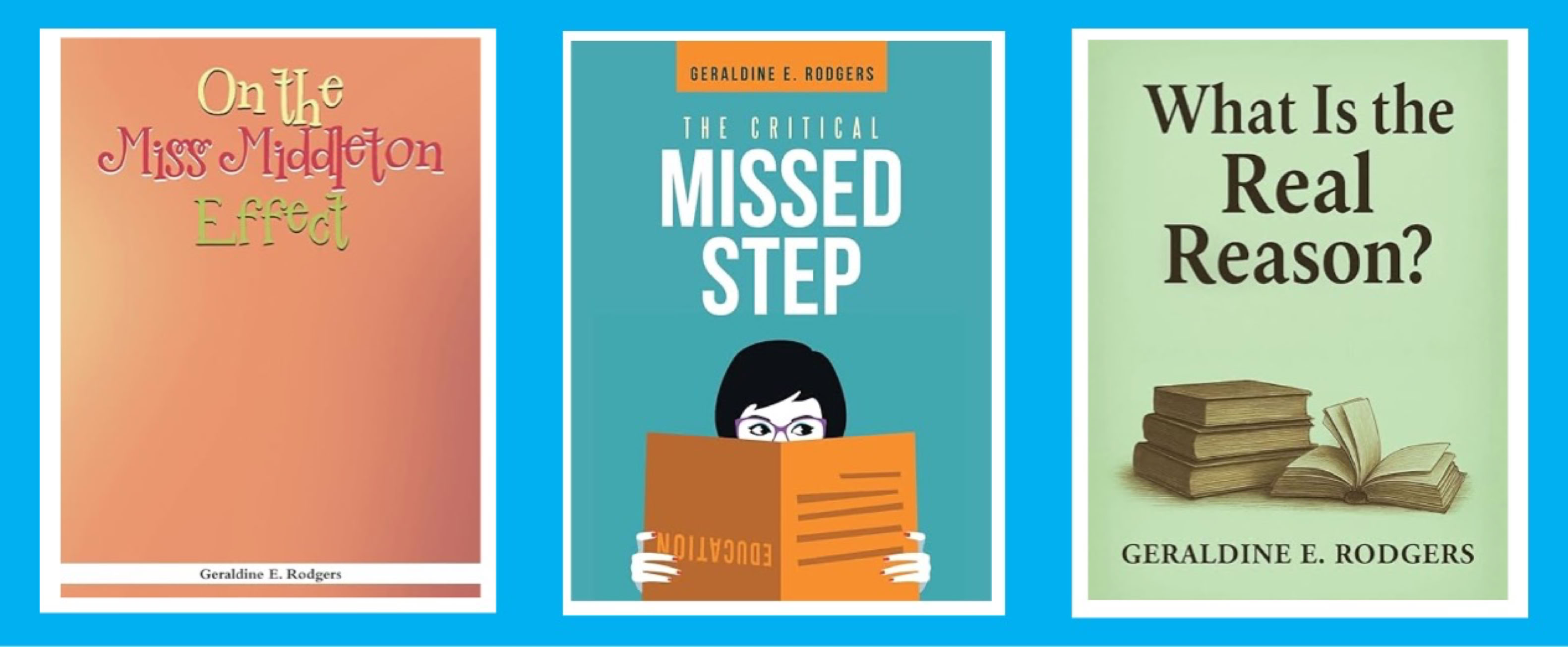
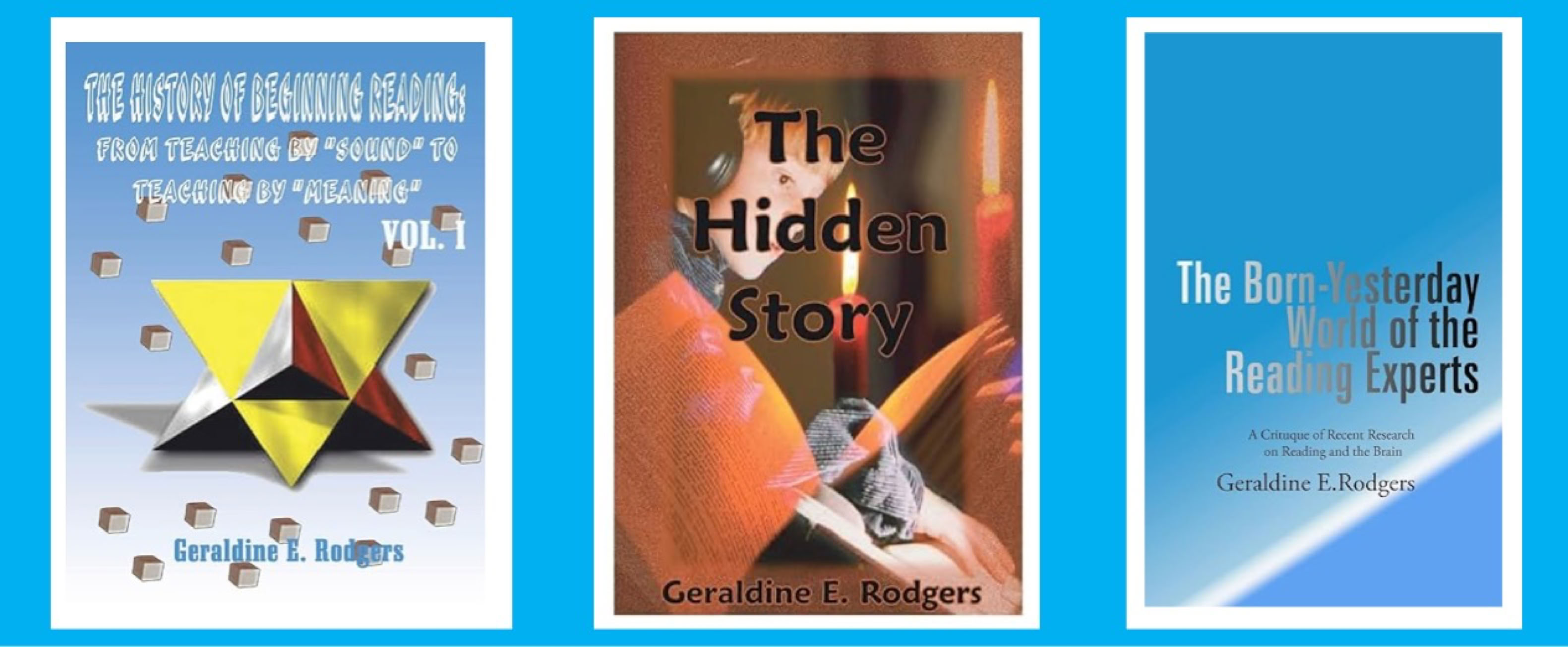
Geraldine Rodgers spent most of her life dedicated to the cause of literacy. She wrote 3 books in her 90’s, including the book “What Is the Real Reason?” at age 99. Gerry turned 100 in December of 2025. The three books she wrote in her 90’s are shown below.
Early Life and Career
Geraldine Rodgers was born in Newark, New Jersey in 1925. Gerry graduated from Lyndhurst High School in 1942, and attended the Washington School for Secretaries in Newark from 1942 to 1943, and then briefly worked for the Office of the Prosecutor of the Pleas of Essex County in Newark in 1943. She then worked very briefly for the DL&W Lackawana Railroad, on West Street in New York - January to May, 1944. During this time, she overlooked the river on her job.
I spent time watching the massive shipments on the river of visible war materials, ship after ship going down the river, on their way to Europe, obviously meant for for the June, 1944, invasion.
All these 73 years later, my memory may be dulled, but I remember such things as planes and tanks being fully visible on those decks. At that time, to get to work, I rode the Lackawanna from Lyndhurst to Hoboken on the other side of the Hudson every morning, and the tracks on either side, from about Secaucus to Hoboken, were lined with vast stacks of war materials, waiting for shipment on the Hudson.
It was memorable, indeed." (1)
Geraldine was a secretary for the Standard Oil Company of New Jersey from 1944 - 1962.
She taught elementary school from 1963 to 1986 in Wayne, New Jersey.
Education
B.S., Fairleigh Dickinson University, Rutherford, New Jersey, Magna Cum Laud, 1963
M.A., William Paterson College, Wayne, New Jersey, 1967
Sabbatical
Geraldine took a two-week leave from the Wayne schools in 1971 to visit Open Classroom schools in England.
She later took a six-months’ sabbatical leave from the schools of Wayne, New Jersey in 1977-1978, during which she observed first grade classes and tested second grade classes in Europe and in the United States. She observed beginning classes in England in 1971, and first and second grades in the United States, Luxembourg, Holland, Sweden, Germany, Austria and France in 1977-1978.
Rodgers is notable for her research and writing on beginning reading and the rating scale she developed. She developed a rating scale for beginning reading books, which she explained and used in her History of Beginning Reading. She also developed a theory that there are two types of readers, one from each end of her scale.
The Reading Rating Scale
Rodgers describes her rating scale in her History of Beginning Reading:
“Meaning” approaches in teaching the reading of alphabetic print are labeled “Code l,” and are considered the lowest on a scale from one to ten.
“Sound” approaches are labeled Code 10, the highest on that scale from one to ten.
Approaches falling in between are indicated by higher or lower code numbers." (2)
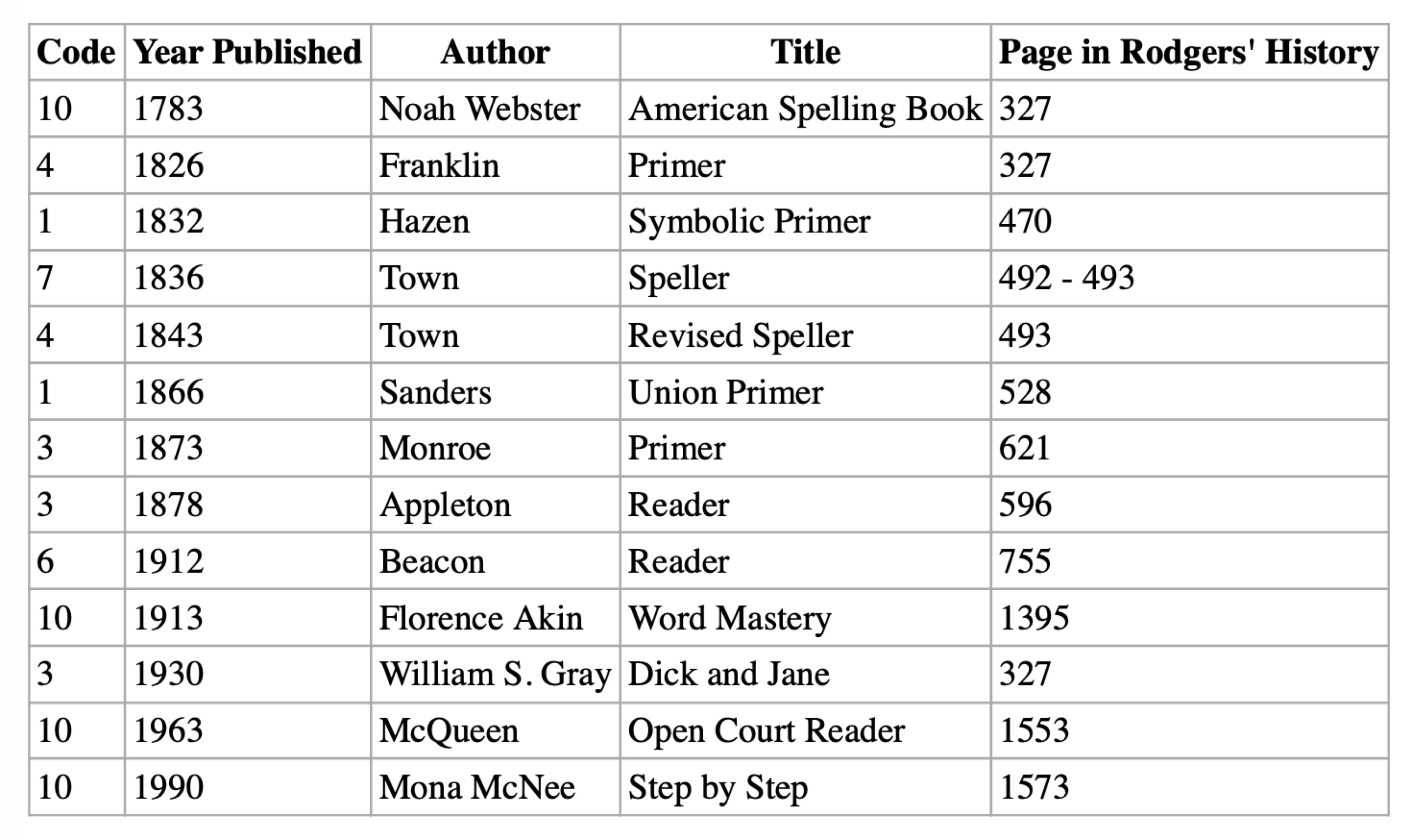
In her History of Beginning reading, she explained her rating scale in more detail and assigned her scale to books used for reading instruction throughout history. A few of these books and their ratings are shown in the table below.
Noah Webster’s American Spelling book, also known as the Blue Backed Speller, is included because it was used to teach both reading and spelling with syllabic phonics. Its use to teach reading is explained on 40L’s Webster’s Way page.
Reading Scale Code of selected books from Rodgers’ History of Beginning Reading
Phonics vs. Whole Language in history
Rodgers also identified a period of whole language teaching from 1826 - 1876, focused on elocution. This period other historical reading dates are shown on 40L’s History of Reading page.
“The “new” way was to drill whole classes, over and over, on sections as short as a paragraph or even a sentence to promote elocutionary tones and “meaning.” A la William Scott Gray in the 20th century Scott, Foresman series, the “new” method was to question the children endlessly on these little snippets of reading matter that they repeated over and over and over.
To my knowledge, no public attention has ever been drawn to this enormous fakery in place by 1835 of replacing real reading instruction and practice with wheel-spinning and useless activity.
The change from meaningful reading practice (“sound”) to elaborate fakery (“meaning”) was promoted by change-agents on both sides of the Atlantic. The change appears to have started in the early nineteenth century, to have been institutionalized in America in 1826, and to have been in full and rank flower by the 1830’s on both sides of the Atlantic....They did it on the fake grounds that they were promoting “meaning.” In its place they recommended what amounted to a lot of gargling exercises to “train” children’s “organs” (“elocution”) and hosts of pointless questions on the “meaning” of simple, self-evident material." (3)
Rodgers' The History of Beginning Reading is comprehensive and well research and documented. She states,
For sixty years, Nila Banton Smith’s appalling disinformation has remained as the primary
historical reference on reading in America....Our education establishment has mindlessly
accepted Nila Banton Smith’s “history” over all these long years, despite the Government’s
almost bottomless fund of tax dollars with which to underwrite a proper history.
Nila Banton Smith’s harmful disinformation therefore remained essentially unchallenged for sixty years until, as a retired primary-grades teacher and private citizen and with only personal funds and no help of any kind, I chose to challenge it." (4)
Sabbatical Research
Geraldine's sabbatical research found that phonics was superior to whole language in both European and American classrooms.
“On my test which is at grade level 2.3, at a time of the year in Europe which was roughly grade 2.3, 90% of the phonic-trained children were at instructional level, and 96% passed above thefrustration level.
The more global [whole language] European classes showed a marked inferiority. Only 74% were at instructional level and 86.5% passed above the frustrational level. What was notable was the degree of extreme failure of a few children in the global groups. Of the total global sample, 2.5% scored below 70% accuracy, but none of the European phonics group scored that low.
For comparison, in the American group, and despite the fact that learning to read English is a more demanding task for beginners, only 1.4% of the phonics children read below 70% in January....
Only 8% of the American phonics classes read below the frustrational level, but 25% of the sight word global group, or one out of every four children in those classes! Yet it should be pointed out emphatically, once again, that the test only concerns very high frequency words and in no way shows how children could perform when sounding out unfamiliar words.” (5)
Rodgers also found that the more phonics based a program was, the better the results:
“Where individual groups were compared, when one group had more phonic background than another (a higher Code number), the same superiority was demonstrated. For instance, the Scott, Foresman Code 2 groups which did not use the Scott, Foresman workbook, “Letters and Sounds,” did markedly worse than Class U.S. 27, the Code 5 Scott, Foresman group which did use the phonics workbook (a relative weak analytic approach which did, however teach short vowels.) ” (6)
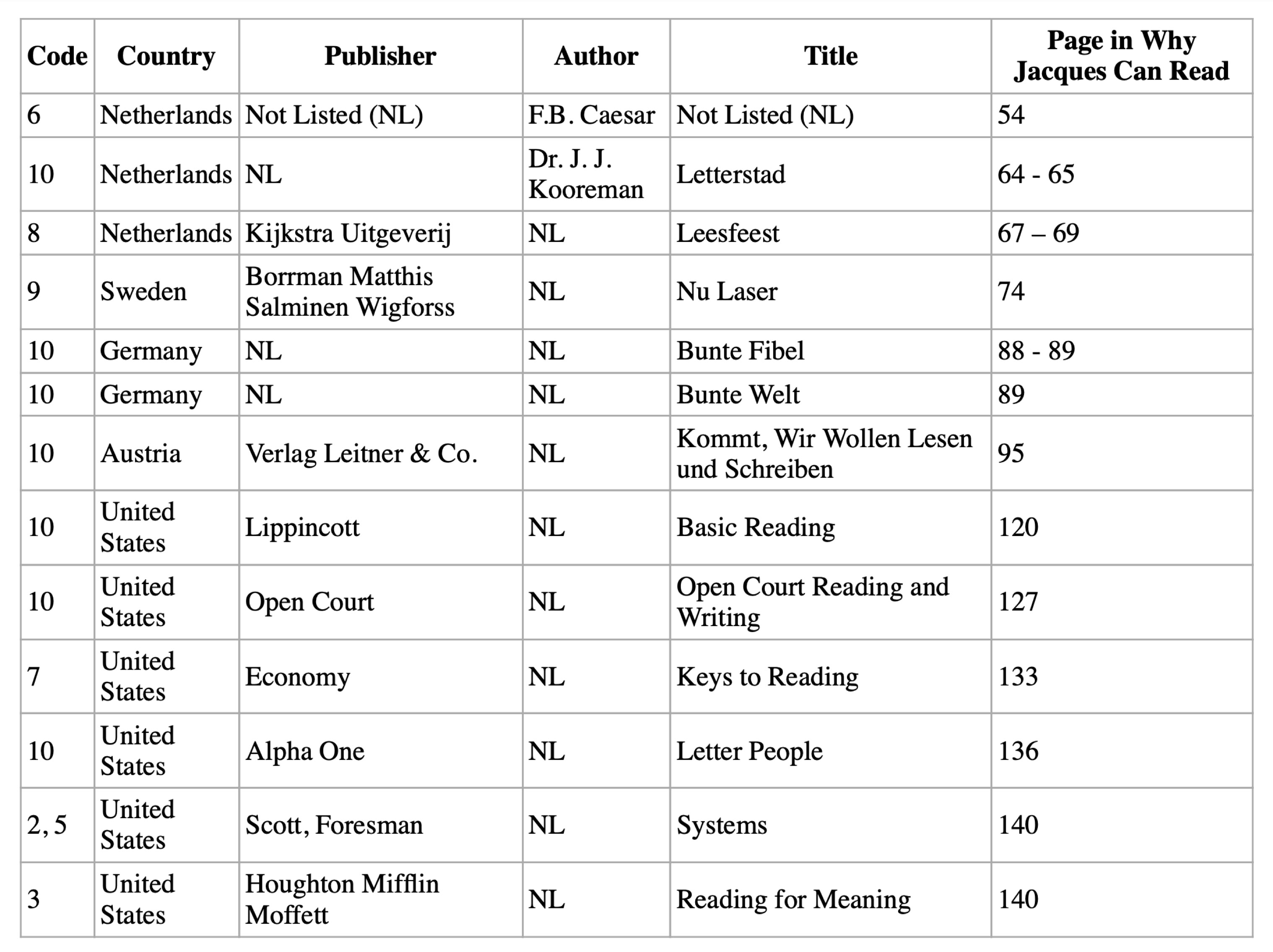
This table below shows a sampling of her review of beginning reading programs during her sabbatical research, with her code scores for each program, with code 1 pure meaning and code 10 pure sound.
Reading Scale Code of selected books from Rodgers’ Why Jacques Can Read
Decline in Today’s Phonics Programs
In the forward to the 2004 edition her book, Why Jacques, Johann and Jan Can Read, she notes that the quality of phonics programs has declined in both Europe and America,
“ It should be mentioned that the 1977-1978, truly phonic, ITA, Lippincott and Open Court
American materials are no more. It is true that a present-day, very weak phonic program carries the Open Court name, but it is in no sense comparable to the 1977-1978 Open Court program, and even gives some sight words to rank beginners.
Unlike the Jacques of 1979, the Jacques of 2004 often CANNOT read. That is because most beginners in France are now being taught to read by the sight-word, global “meaning” of print, instead of by its “sound.” (7)
Theory of Two Types of Readers
Rodgers' research led her to believe that there are two types of readers, one from each end of her reading scale.
“Messmer’s German research early in the next century turned up two types of readers:
objective and subjective.
The objective read by syllables;
the subjective read by whole words and guessing. (8)
Brain research on reading at the time also led her to believe that there were two types of reading, each processed on a different side of the brain.
“ Logically, therefore, if the reading of Kana sound-bearing script, like the reading of alphabetic sound-bearing print, is processed through the left angular gyrus area of the brain, the reading of Kanji meaning-bearing script (and the reading of its equivalent, sight-words taught by the “meaning” method) should be processed through the mirrored counterpart, the RIGHT angular gyrus area of the brain. The left angular gyrus areas and the right angular gyrus areas in human brains should then provide the anatomical basis for processing the only two types of visual writing which are possible for humans: sound-bearing, or meaning-bearing. ” (9)
A central part of her many books and online articles is this difference, and the idea of not just two types of teaching, whole language vs. phonics, but also two types of readers, meaning based or sound based.
Two different and opposite kinds of readers are developed at the very beginning stages of reading instruction as the result of different and opposite kinds of teaching.
One kind of reader is taught to read by the ‘sound’ of print, and reads automatically and with great accuracy. The other kind of reader is taught to read by the ‘meaning’ of print, as Chinese characters are read, and not only reads inaccurately,
but is actually encouraged to do so by so-called ‘psycholinguistic guessing.
Geraldine Rodgers kept working until age 99, when she wrote her last book. She spent most of her adult life committed to her vision of making the historical reasons for illiteracy available to the public.
It’s never too late to make a difference.
References:
1. Rodgers, Geraldine, email interview, 4 February 2017.
2. Rodgers, Geraldine (2001). The History of Beginning Reading, from the Forward, page vi.
3. Rodgers, Geraldine (2001). The History of Beginning Reading, page 456.
4. Rodgers, Geraldine (2001). The History of Beginning Reading, pages 1080 - 1081.
5. Rodgers, Geraldine (2004). Why Jacques, Johann and Jan Can Read. pp. 173–176.
6. Rodgers, Geraldine (2004). Why Jacques, Johann and Jan Can Read. p. 176.
7. Rodgers, Geraldine (2004). Why Jacques, Johann and Jan Can Read. pp. 7–8.
8. Rodgers, Geraldine (2001). The History of Beginning Reading, page 556
9. Rodgers, Geraldine (2001). The History of Beginning Reading, page 1123